

There is a particular kind of pressure that comes with planning a 4-room HDB renovation for your own family when you are a senior interior designer. Every decision is highly visible, every trade-off becomes deeply personal, and unlike working with clients, you cannot simply walk away at the end of the design consultation.
When Jeannie Lai, one of Spacious Planners’ senior designers, finally began planning the renovation of her own home, she had two children under three, a 40+ years old 4-room HDB flat of roughly 1,000 square feet, and almost 2 decades of professional experience designing family homes for others.
The question she faced was the same one her clients face every time: how do you make a constrained space feel genuinely liveable, not just organised, but restful for a family at full capacity?
Her answers are instructive. Not because they are extraordinary, but because they are precise. And precision, in a resale flat of this age and size, is what separates a home that functions from one that sustains.
She Designs Homes for Families Like Hers.
Here Is What She Built for Her Own.
The Master Bedroom: A Spatial Rethink for a 4-Room HDB Renovation
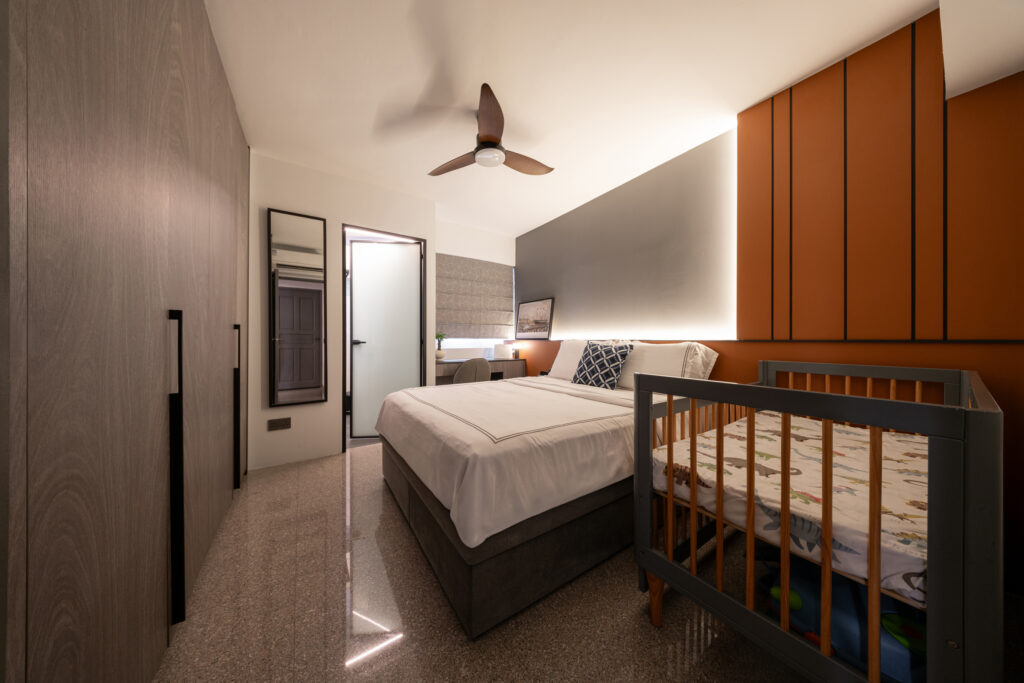
The original master bedroom, as is common in older 4-room HDB layouts, was competent but not generous. It could hold a bed, a wardrobe, and not much else.
Jeannie shifted the boundary between the master bedroom and the kitchen zone. Absorbing a portion of underused corridor space to gain enough room for two things: a full-length wardrobe and a cot for their third child to come.
This is not a dramatic intervention. It is a measured one. The gain in the bedroom is less than 2 meters, but the practical difference is significant: one parent can settle the baby without disrupting the rest of the household. The wardrobe, now full-length, means there is no overflow clothing elsewhere in the flat. Two problems, one spatial adjustment.
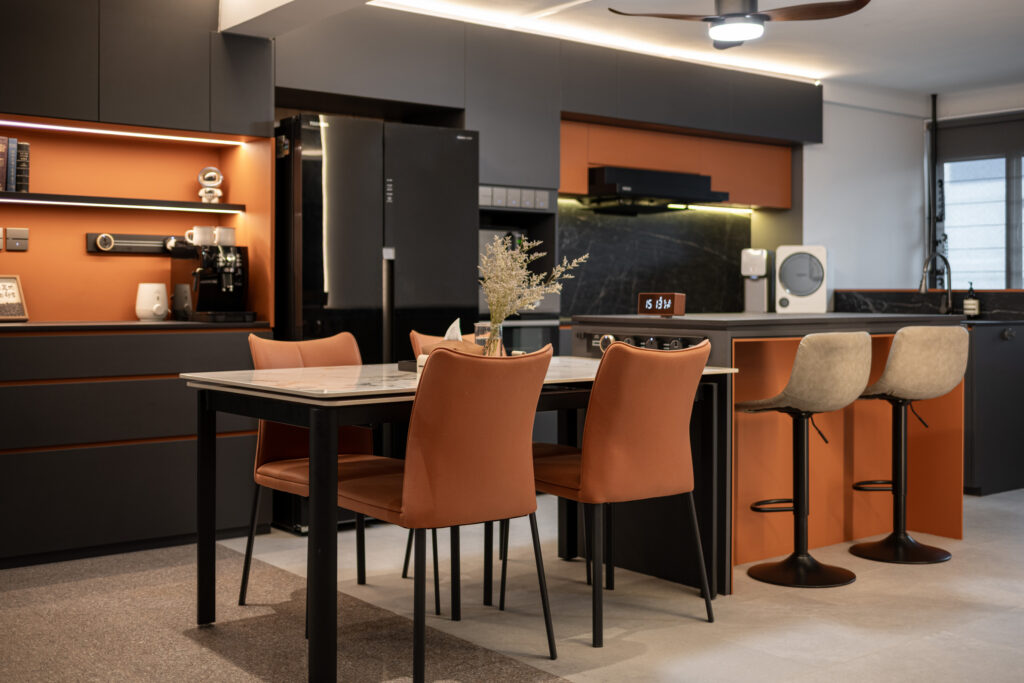
The kitchen island: The center of gravity
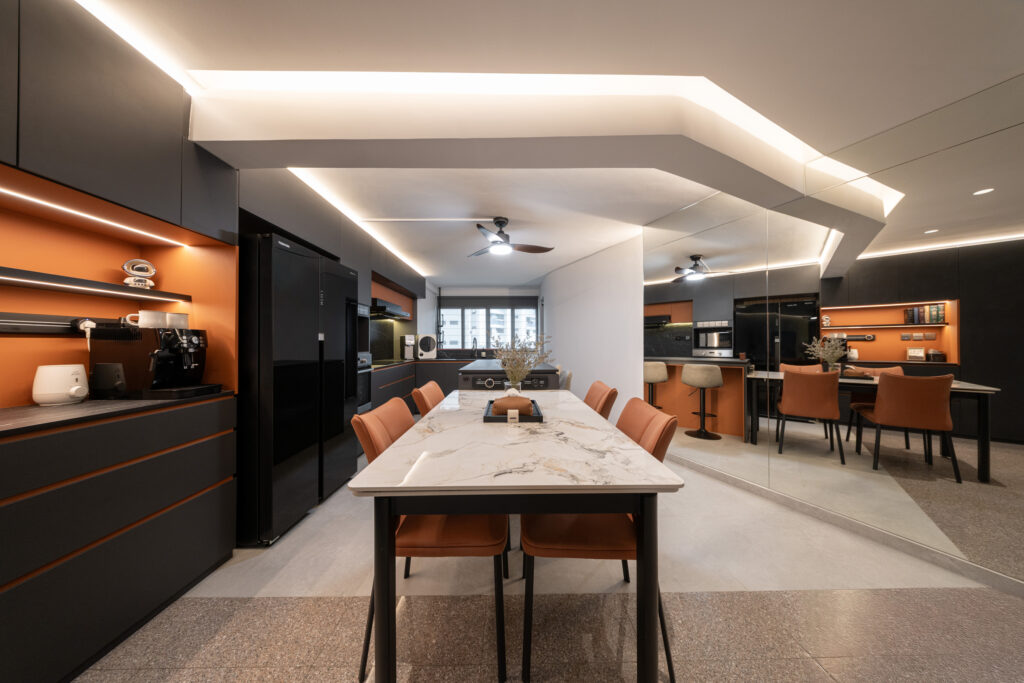
The original kitchen in this flat was enclosed as most kitchens are in older HDB stock. The wall between the kitchen and the dining area created a separation that made sense in a different era of cooking and family life. It made less sense for a household that needed to supervise three young children while preparing meals, receive in-laws on weekends, and host friends in a home that genuinely reflects how they live.
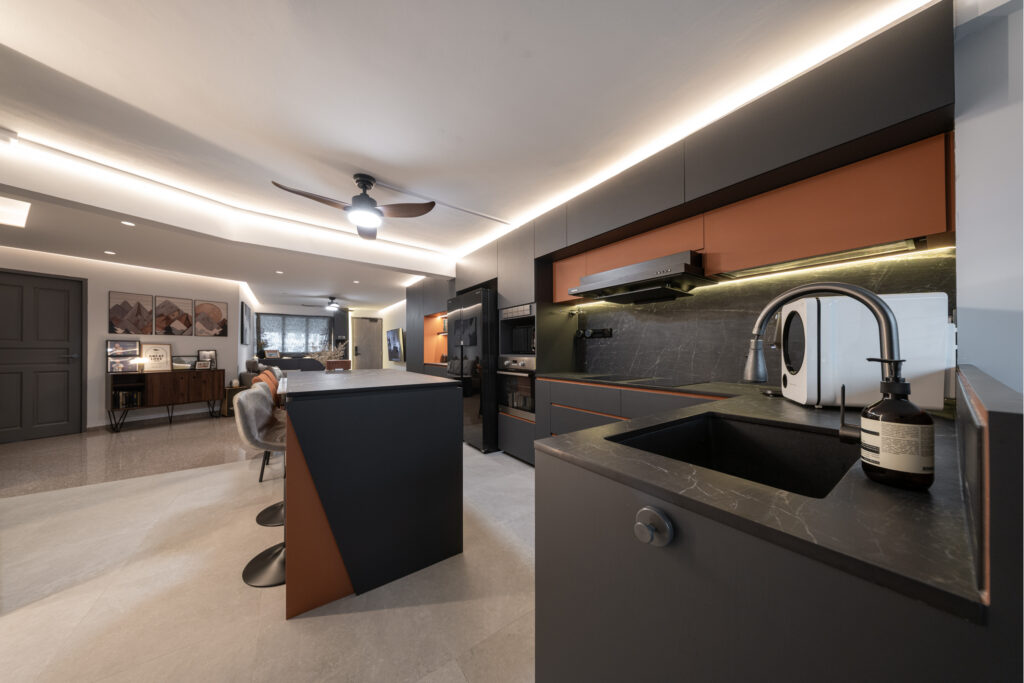
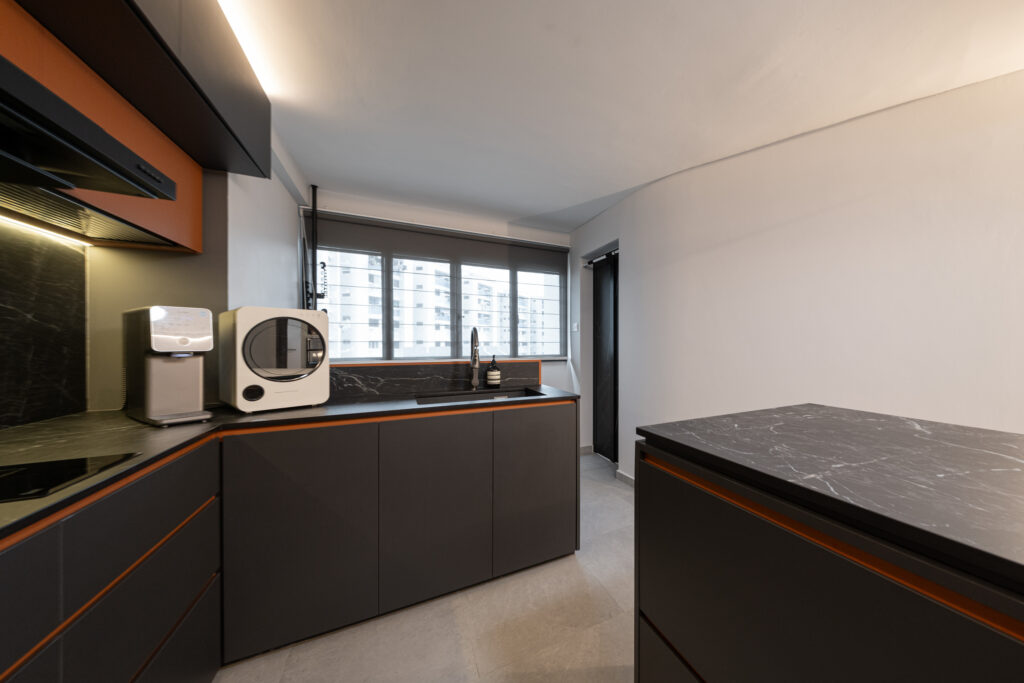
The wall came down. In its place: a kitchen island that extends into and joins the dining table. One continuous surface. The person cooking is no longer isolated from the room. The children can be seen. Guests can sit at the counter. Meals become part of the room rather than a separate event happening behind a door.
This is the kind of decision that reads as aesthetic on a photograph but is fundamentally functional in daily life. The island is not a design statement. It is a solution to the problem of living.
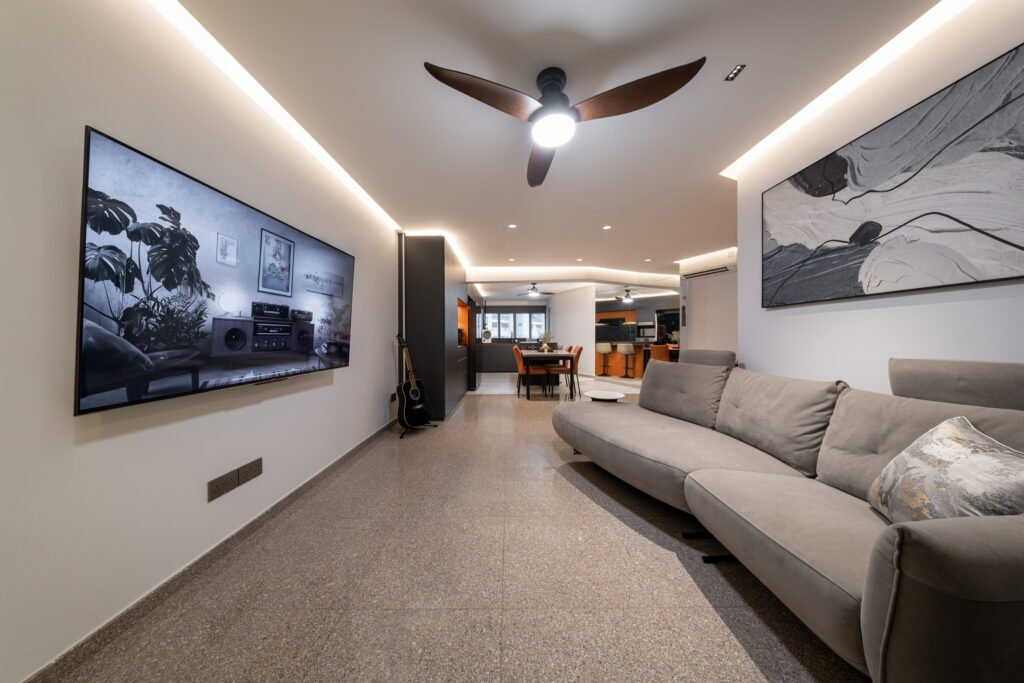
The palette: The counter-intuitive call
Families with young children overwhelmingly default to bright, light interiors. It is a reasonable instinct. Brightness suggests openness, and openness is the antidote to a small flat.
Jeannie made a different call. The palette is dark, moody, and deliberately hotel-adjacent. Deep tones. Considered materials. Layered lighting rather than overhead brightness.
The Lego sets are still out. The sippy cups are still on the counter. A dark home with three children under five is not a contradiction. It is a considered position. The darkness is not about minimalism or the suppression of family life. It is about giving the adults in the household a space that feels like theirs, even when it is also entirely the children’s.
The result is a home that feels, in Jeannie’s words, like you can exhale. That is not a small achievement in 1,000 square feet with a full household.
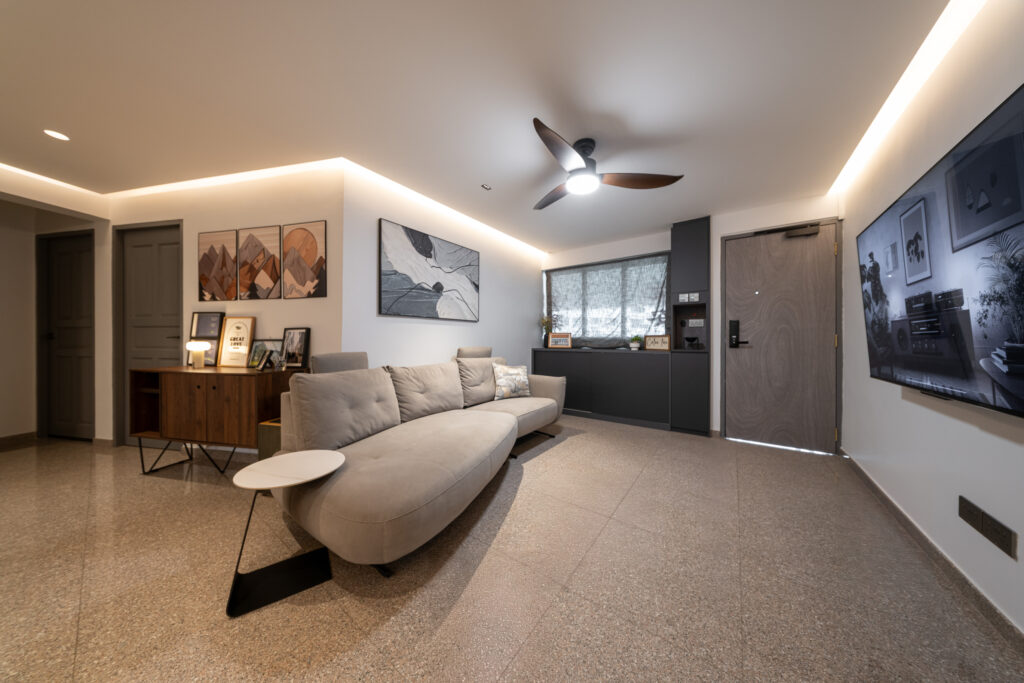
Full Hometour: Hougang
What This Project Teaches Us About a Resale 4-Room HDB Renovation
Jeannie’s family home is not an exception. It is a demonstration of what the renovation process looks like when the brief is taken seriously from the first conversation.
The pre-design planning phase which ran for one to two months before a single wall was touched is where the precision comes from. It is where the trade-offs are examined, the spatial plan is tested, and the decisions that will shape a home for the next decade are made deliberately rather than by default.
The works themselves took two months from commencement to handover. That timeline is a function of pre-planning, not speed. When the brief is clear, the execution is direct.
If your family is in a similar position: a resale flat that no longer fits how you live, with constraints you are not sure how to solve. The place to start is not a moodboard. It is a conversation about how your household actually works.
That conversation is what the first consultation at Spacious Planners is for. 22+ years and more than 1,400 completed projects means we have had a version of it before. We know where the decisions are, and we know how to help you make them well.
Book your first consultation via contact us page. No obligation. No pitch. Just the conversation your home needs.